Your first MCP server, your first Skills, your first multi-agent system
13 hours to stop copying and pasting into a chat: 5 MCP servers, your Skills and a multi-agent system running on your machine. In Python. Taught in Spanish.
With Daniel Alfocea
- of video
- 13 h
- modules
- 11
- level
- intermediate
In Spanish. This program is taught in Spanish: its videos, exercises and exam are in Spanish. This page is a translation to help you decide.
Who it is for
You program in Python at an intermediate level and use an LLM as a user. You don't need to know anything about MCP or agents.
About the program
Your AI can’t open a file
In 13 hours you go from copying and pasting into a chat window to having 5 MCP servers, your first Skills and a multi-agent system running on your machine. In Python.
Language: the course is taught in Spanish. The videos, the cheatsheets and the exam are in Spanish. This page is the English description only.
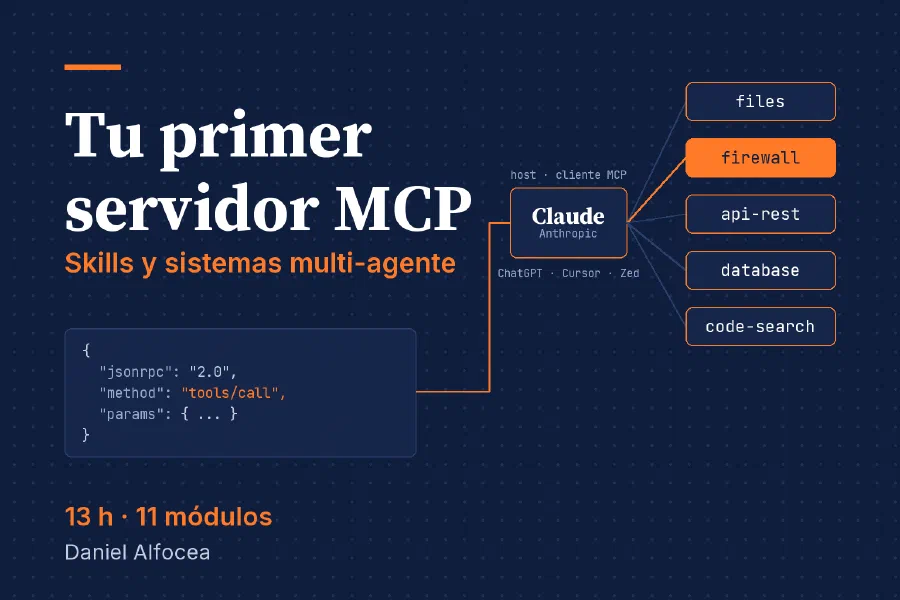
MCP is the protocol Anthropic published in late 2024 so a model can read your repository, query your database and call your APIs without you pasting anything into the chat. Cursor, Zed, Sourcegraph and half the tooling industry already speak it.
Everyone mentions it on LinkedIn and almost nobody has written one. That’s where this course gives you an edge.
It’s for you if you program in Python at an intermediate level and use a model as a user. You don’t need to know anything about MCP or agents: you start from zero and finish with things of your own working.
It isn’t for you if you’ve never written code, because I assume you can write a function and call an API. Nor if you want to build a chatbot with the OpenAI API, which this isn’t about. And if you need MCP at bank scale, with OAuth and Kubernetes in front, I haven’t recorded that yet.
I want it to read my repo by itself
Monday morning
You open Claude Code, ask it something about the repo at work, and the model queries the database, finds the function through the syntax tree and answers with real data. You haven’t pasted anything.
That’s what’s on the other side of these 13 hours.
You end up with five MCP servers written by you, in Python and with their tests. The first talks to a real database. The second wraps a REST API with its authentication. The third indexes your own code by AST, so the model understands your repository without you pasting files. The fourth edits firewall rules on Linux, Windows and macOS from natural language, with a dry-run mode so you don’t get a nasty surprise. The fifth reorganizes your disk, detecting duplicates by content hash, not by name.
You also get your first Skills for Claude Code, written so they activate on their own when they should instead of ending up forgotten in a .md nobody reads.
And an orchestrator with three agents working at the same time on the same task, with the patterns that hold up and the ones that always break.
All of it runs, is tested and you can show it on Monday at work.
What you’ll save yourself
You’ve had Claude or ChatGPT open in a tab for months. It helps, quite a bit at times, but it touches nothing of yours: you open the file, paste it, read the answer, apply the change, copy the error and paste it again.
The model thinks and you do the dirty work.
And the day you get fed up and decide to automate that trip, you find that connecting tools to an OpenAI model isn’t done the same way as at Anthropic, and Gemini goes its own way. You change provider and rewrite half your code.
Until recently there was no standard way to do this, so it isn’t your fault. Now there is one, and what you save here are the fifteen detours that cost me a month before I found the one that holds.
Who is selling you this
My name is Daniel Alfocea. With Alfonso Muñoz I wrote MCP Seguro, and I have more than a hundred tools published on GitHub, one of which ended up inside Kali.
That’s the résumé, and it only serves one purpose: so you know what’s inside wasn’t copied from the documentation. I build MCP servers for people who pay, they break on me, and what you’ll see is what was left standing after breaking them.
What isn’t in the official documentation
Almost everything else is. These things aren’t, because they come from fighting with them:
Why an MCP server that works perfectly on your machine falls over as soon as you connect it to someone else’s client, and which part of the configuration is almost always to blame.
The difference between a Skill and an MCP Tool, which sounds like a nitpick and is the reason many people build the second when they needed the first.
When MCP isn’t the answer and what you need is a plain old CLI, even if the one using it is an AI.
What tool poisoning is, how someone slips instructions inside the description of a third-party tool, and the five questions I ask before installing an MCP server I didn’t write.
Why the agent that steps on itself is the most expensive anti-pattern in multi-agent systems, and how to see it coming before it eats your token budget.
I won’t give away any answer here. They’re all inside.
What it costs
€180, once.
You bill that in a morning, or two if you’re stretched. It pays for itself the first afternoon you don’t spend fighting a handshake you don’t understand.
For that money you get 13 hours of video in 10 modules and 4 exercises with their statement and answer. It also comes with 3 PDF cheatsheets, more than 25 code examples you can copy and that work, and a final exam with a verifiable certificate.
You also join the platform’s community, where questions that don’t fit in a video get answered. And you write to me if you get stuck.
Access is for life. When I update the course, you get the new version without paying again.
Daniel Alfocea
P.S. If what holds you back is the price, do a quick calculation: how many hours have you spent this year copying and pasting code into a chat window. Multiply them by what you earn per hour. €180 is what it costs you to stop doing it.
I don't want to lose another month like this
The syllabus
13 hours of video in 10 modules. Each module ends with a quiz so you know whether you got it before moving on, and the course closes with a 30-question exam and its certificate. Module and lesson titles in the course are in Spanish.
- What MCP is and why it changes how you work with AI. From isolated models to models that read files, query databases and call APIs. The 3 actors, the 4 primitives and JSON-RPC 2.0 underneath.
- Anatomy of an MCP server. Lifecycle of a connection, transports (stdio and HTTP/SSE), Tools with their schemas, Resources, Prompts and Sampling. Testing with MCP Inspector. The Python and Node.js environment problems you’re going to hit. And the five complete servers.
- Skills: reusable behaviors. Anatomy of a Skill that activates on its own, the 500-line rule, progressive disclosure, and how to write them so they can be reused across projects.
- Multi-agent orchestration. Parallel, sequential and hierarchical patterns. A demo with 3 agents on a real task, in Claude Code and in Python with asyncio. And the anti-patterns that get expensive.
- Security in MCP. Tool poisoning, indirect prompt injection, command injection, path traversal and data leaks through poorly isolated context. Validation with Pydantic and a defensive checklist.
- Exercise 1: automatic Pull Request review. A multi-agent system that reviews a PR before it reaches main.
- Exercise 2: SOC alert triage. You’re the analyst, alerts come in and you decide with a specialized agent at your side.
- Exercise 3: product launch. Agents in parallel for copy, strategy and communication.
- Exercise 4: from manuscript to published book. A multi-agent editorial pipeline from start to finish.
- Extras. Cheatsheets on MCP, Skills and security, plus two videos: MCP versus CLI, and Skill versus MCP.
Syllabus
45 lessons in 11 modules. The ones marked “Sample” can be watched without logging in.
01¿Qué es MCP y por qué cambia cómo trabajas con IA? 3 lessons
- ¿Qué es MCP y por qué te importa? (Parte 1)
- ¿Qué es MCP y por qué te importa? (Parte 2)
- Slides del módulo 1
02Anatomía de un Servidor MCP 11 lessons
- Cómo funciona por dentro (Parte 1)
- Cómo funciona por dentro (Parte 2)
- Configurar un servidor MCP
- Resolución de problemas típicos en Python
- Instalación de NPX y problemas típicos en Node.js
- Ejemplo: MCP con base de datos
- Ejemplo: MCP con API REST
- Ejemplo: MCP de búsqueda en código
- Ejemplo: Firewall MCP
- Ejemplo: File Organizer MCP
- Slides del módulo 2
03Skills: Comportamientos Reutilizables 4 lessons
- ¿Qué es un Skill y para qué sirve? (Parte 1)
- ¿Qué es un Skill y para qué sirve? (Parte 2)
- Ejemplos de Skills en acción
- Slides del módulo 3
04Orquestación Multi-Agente 5 lessons
- Orquestación Multi-Agente
- Demo: Orquestación con Claude Code
- Demo: Orquestación con Python
- Ejemplo guiado paso a paso
- Slides del módulo 4
05Seguridad en MCP 4 lessons
- Seguridad en MCP (parte 1)
- Seguridad en MCP (parte 2)
- Ejemplo: servidor MCP seguro
- Slides del módulo
06Ejercicio 01 - PR Review 3 lessons
- Enunciado
- Práctica interactiva
- Solución
07Ejercicio 02 - SOC Triage 3 lessons
- Enunciado
- Práctica interactiva
- Solución
08Ejercicio 03 - Lanzamiento de Producto 3 lessons
- Enunciado
- Práctica interactiva
- Solución
09Ejercicio 04 - Editorial 3 lessons
- Enunciado
- Práctica interactiva
- Solución
10Extras: Cheatsheets de Referencia 5 lessons
- Cheatsheet MCP
- Cheatsheet Skills
- Cheatsheet Seguridad
- MCP vs CLI: cuándo usar cada uno
- Skill vs MCP: cuándo usar cada uno
11Examen Final 1 lesson
- Examen de certificación
Sample lessons
Watch them before you pay.
-
MCP vs CLI: cuándo usar cada uno
Who teaches it

Daniel Alfocea
Twenty years in security and development, now focused on applied AI.
The two reviews with text that this course has
Este curso me ha permitido tener los conceptos claros y crear mi propio MCP y skills. Las explicaciones son muy claras, además ofrece muchos ejemplos y resúmenes de la teoría. Gran trabajo.
Carlos Molina
buen curso, con buenas capacidades para entender bien qué es un MCP, las skills y el sistema multiagéntico
Germán Álvarez
Reviews
Fantástico
buen curso, con buenas capacidades para entender bien que es un MCP, las skills y el sistema multiagentico
Este curso me ha permitido tener los conceptos claros y crear mi propio MCP y skills. Las explicaciones son muy claras, además ofrece muchos ejemplos y resúmenes de la teoría. Gran trabajo.
Questions
Do I need to know anything about MCP to start?
No, and that’s exactly the starting point. The course begins assuming you program and have used a model as a user. I assume nothing about MCP, agents or function calling.
If the word sounds familiar but you couldn’t explain it in two sentences, you’re exactly where you should be.
13 hours? I don't have time.
Nobody does, me least of all. That’s why it’s 10 modules you watch separately, not a marathon you have to start and finish in one sitting.
Two sessions a week and you finish before the month is out. And if you really don’t see the time, don’t buy it yet: a course left unopened is money thrown away, and with a guilty conscience on top.
Isn't this in the official documentation?
Almost all of it, yes. The car manual also has the tightening torque for the wheels.
What the documentation doesn’t tell you is what breaks when you put it in front of someone else’s client. Nor does it say which of the ten ways to set it up is still standing a year later. That comes from having broken it, not from having read it.
Do I need advanced Python?
An intermediate level is more than enough. You won’t write metaclasses or anything exotic: you’ll write servers that receive JSON and answer JSON.
If you can write a function, read JSON and call an API, you’re set.
Does it work with my stack? And at my company?
MCP is an open protocol, like HTTP. It isn’t Anthropic’s even though Anthropic published it, which is why Cursor, Zed, Sourcegraph and half the tooling industry already speak it.
The course code is Python and the clients we use for testing are Claude Desktop and Claude Code, which is where the protocol is most mature. What you write there works the same against any other host that speaks MCP. One of the five servers manages firewall rules on Linux, Windows and macOS, so portability is discussed with code in front of you.
For your company there’s an honest caveat: this doesn’t set up a server behind OAuth with role-based permissions and Kubernetes in front. That’s level 2 and I haven’t recorded it yet.
What if it's not useful to me?
Above you have the section on who it isn’t for, and it isn’t there as decoration: it’s written so you back out if you recognize yourself in it. I’d rather lose the sale than have you make it and then both of us lose the afternoon.
The terms of purchase say what happens after you buy. They’re in the footer and in the checkout itself.
Why €180 when there are free videos on YouTube?
You can try, and I encourage you to. Come back after twenty hours of disjointed videos, half-read documentation and 2024 tutorials that no longer work because the protocol moved things around.
On YouTube you get the pieces. Here you get the order, the five complete servers and someone to ask when you get stuck. What you’re buying is the month you won’t lose.
What if the protocol changes in six months?
Part of it will change, and I won’t tell you otherwise. The tools around it move every quarter.
The foundations don’t. The 4 primitives, JSON-RPC and the client-server architecture have been stabilizing since late 2024. When something gets old I update the course, and you get the new version without paying again.
Is this a subscription?
Who it is forYou program in Python at an intermediate level and use an LLM as a user. You don't need to know anything about MCP or agents.