Salary negotiation, vol. 1
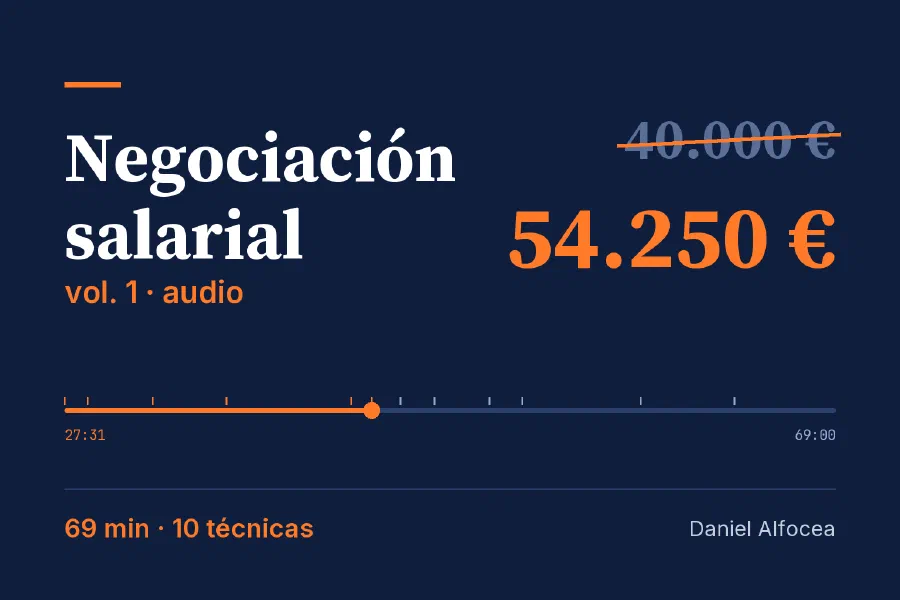
69 minutes on the ten things almost everyone gets wrong when negotiating their salary, and what to do instead. They come from almost 200 interviews done on purpose for practice. The audio is in Spanish.
With Daniel Alfocea
- of audio
- 69 min
- techniques
- 10
- level
- introductory
In Spanish. This program is taught in Spanish: its videos, exercises and exam are in Spanish. This page is a translation to help you decide.
Who it is for
You have an interview or a salary review coming up and want to know how that game is played before you sit down. You don't need to be good at negotiating.
About the audio
You’re leaving money on the table every month
Ten techniques for negotiating your salary, in 69 minutes. For your next interview, or for the review you’ve been putting off for months.
Language: the audio is recorded in Spanish. There is no English audio or transcript. This page is the English description only.
Let me explain.
Almost everyone is bad at negotiating, and even worse at negotiating a salary.
It’s not that people aren’t worth what they ask. It’s that nobody ever taught you how this game is played. They don’t teach it at university. Your company negotiates for itself, and that’s normal; what’s odd is that you don’t negotiate for yourself.
While you improvise, the person across from you plays it every day. They know what to ask so you name a figure that doesn’t suit you, almost always lower than you deserve.
I used to be one of those who improvised.
Albacete, 2018 and almost 200 interviews
My name is Daniel Alfocea. I’ve spent twenty years in development and security, but what I’m going to tell you here doesn’t come from that.
In 2018 I moved to Madrid from Albacete with next to nothing. I was a junior, paid very little, and one day I thought what everyone thinks: I want to earn more.
The difference is that instead of staying at the complaining stage, I did two things.
The first was spending six months on an HR course, every afternoon. There were twenty of us and nineteen worked in HR. I was the odd one out and they kept asking what I was doing there. I always gave the same answer: I wanted to see selection processes from the inside so I could use them in my favor.
The second matters even more, because theory alone is worth nothing. I started doing interviews like crazy. In the first year I did almost 200, an hour a day, and some afternoons three in a row.
I wasn’t interested in the job and often it wasn’t even a fit. What I wanted was practice: the nerves, the posture, what I said and above all what I held back. And to watch from very close how they behaved. I’m a data person, and with twenty interviews you have nothing.
Every time I came out I wrote down what had worked and what hadn’t, and tried it in the next one.
Today I negotiate without my voice shaking, and I ask for what I ask for using data. And it makes no difference whether you negotiate in Spain, Latin America or the United States, because the substance is the same everywhere.
What’s inside
I have a cheat sheet with many more, but here are the ten I see fail again and again. The ones that cost the most. And what to do instead.
Things like these:
Why asking for “42,500” puts you in a better position than asking for “40,000”, and why almost everyone does exactly the opposite.
The question that gets you to set your own ceiling, without noticing you just did it.
The mistake you’ve probably already made before saying the first figure.
What you really signal when you accept an offer you like on the spot, and why it ends up costing you a lot.
The resource that is hardest to use in a negotiation. It lasts three seconds and can be worth thousands of euros.
The belief that makes you ask for less than you’re worth. Almost everyone I know has it. Maybe you do too.
What exactly to ask for when they give you the classic “we can’t reach that figure”. Almost nobody asks for it, and a good part of the money stays there.
The move that looks like the smartest of all, and because of which some people end up out of the company in under a year.
And the real reason your boss doesn’t value your work. With a warning that stings, because a good part of the blame is yours.
None of the answers are on this page. They’re all inside the audio.
The chapters, with their minute marks
It’s a single 69-minute track, marked inside. You can go straight to the point that interests you, or come back to the one you need the night before the interview. The chapter titles below are translated; in the audio they are in Spanish.
- 00:00 What you’re going to hear and what you won’t find here
- 02:04 Albacete, 2018 and the almost 200 interviews
- 07:52 The mistake you’ve already made before saying the first figure
- 14:30 Who names the figure first, and the question that gets you to name it
- 25:41 The range that always leaves you at the bottom
- 27:31 Why the round number works against you
- 30:03 What you signal when you accept on the spot
- 33:06 Negotiating against yourself in the same sentence
- 38:03 The belief that pins your figure low
- 41:00 Giving in without asking for anything in return
- 51:33 The outside offer as a bluff, and the counteroffer trap
- 59:56 Waiting for your boss to notice on their own
I’ve tried each of these techniques myself, including the times I screwed up, and there were some. That’s why I can tell you about them first-hand and not from hearsay.
What it costs and why that price
It’s €90, paid once, and the audio is yours. No subscription and no second payment.
Stop for a moment and do the math.
One of these techniques, used well, won’t raise your salary by 90 euros. It will raise it by hundreds. And not once: every month, for as long as that job lasts. On top of that, the new figure is the base your next raise is calculated on, so the effect carries on for years.
You get the price back the first time you open your mouth. The rest stays in your pocket.
If it still seems expensive, don’t buy it. An audio you buy grudgingly goes unlistened, and then you really have thrown away 90 euros.
I'll pay the €90 and listen today
Cheers,
Dani
P.S. If you’re hesitating over 90 euros right now, notice one thing. That reluctance of yours to talk about money is exactly what’s costing you thousands of euros in every negotiation. The audio is about just that.
Syllabus
1 lesson.
Negociación salarial, vol. 1 1 lesson
- Las diez técnicas, del tirón
Who teaches it

Daniel Alfocea
Twenty years in development and security, and almost 200 interviews done for practice.
Questions
Is this for technical people?
No. There’s no code and nothing about computing. It’s about the conversation where your salary gets decided, and that conversation is the same for a developer, a sales rep and the person who does the accounts.
I made it because my students kept asking me, and they are technical. But what’s in it works the same in any job where someone names a figure and you have to answer.
Are 69 minutes worth €90?
It depends on what you do after listening.
If in your next negotiation you get €100 more a month, that’s €1,200 a year, and your next raise is calculated on top of that figure. That’s the small case.
What you won’t find here is a long explanation with twenty examples per technique. These are the ten things I’ve seen cost people the most, told straight and one after another. If you want someone to guide you for weeks, this isn’t the place.
What if I've negotiated before?
Better, because you’ll recognize several of the ten and it will sting.
Almost everyone has negotiated at some point, nearly always improvising. It goes well now and then and costs you the rest of the time, and without a method there’s no way to know which one you got. If you go over your last negotiations while you listen, you’ll be able to point to the exact minute where the money slipped away.
Can I listen on my phone?
Yes. You log in to your account from your phone’s browser and press play, with the audio marked in chapters so you can jump to the one you want.
It’s designed for that: the commute, or the walk the night before the interview.
Is it only for interviews?
No. Several of the ten are for when you’ve been in a company for a while and want a raise.
The last one, in fact, is about why your boss doesn’t know what you do, and that has nothing to do with any interview.
What if I negotiate outside Spain?
The substance is the same. Who names the figure first works the same in Madrid as in Bogotá or Austin, and so does what happens when you stay silent.
What changes from country to country is the figures and some legal details. In Spain and the EU, for example, they can no longer ask you what you were paid before. Inside, I tell you what to do about that.
Who it is forYou have an interview or a salary review coming up and want to know how that game is played before you sit down. You don't need to be good at negotiating.